Editor’s note: September 1, 1939, two days before the declaration of war, Britain imposed mandatory nightly black-outs to prevent enemy aircraft from identifying targets. The black-outs resulted in many people spending long, quiet hours at home once darkness fell.
Years ago I knew an old schoolmaster who, after his retirement, had made a hobby of landscape painting. All through the summer months, and on any mild winter’s day, you would meet him stepping out briskly with his folding easel, sketching stool, paints and canvas—a lean, dapper, grey-bearded man, with weather-beaten face and twinkling eyes. A man who enjoyed talking to any man, woman, or child he met, who had his own cheery philosophy of life and sent every one away smiling from the encounter. A man who in the evening of his days was leading a contentedly full, happy life.
***
Even then I did not realise, till after his death, all that he had gained from it. It happened that I was invited to his house to choose one of his pictures as a souvenir. I was one of the merest of acquaintances, just one of the many who used to enjoy a gossip with him by the way, and I had never entered his house during his lifetime. I remember gazing about me in astonishment at the overwhelming evidence of his industry. Not only were the walls of every room completely covered with pictures, but there were stacks of them in a lumber room as well. And, looking at them, one realised that not one moment spent upon them had been wasted. They were not great art. They would never make him famous. Probably by this time, except in the houses of those who loved him, they have become real lumber and have long ago been destroyed. But in them he had captured the sunlight shining on the buttercup fields, lighting up old red roofs, glinting on the surface of a running stream and on the grey-green of overhanging willows. He had caught the sky in all its moods, dappled with drifting cumuli clouds or dark with storm. And he had looked at it all with the eyes of understanding and painted the best he knew. Gazing at those pictures, you felt how he had enjoyed painting them. They had taken him into another world, shown him the beauty that lies hidden in simple, everyday things. No wonder he was a very happy man.
***
All this comes back to me now in reflecting how much more in the months—perhaps even in the years—to come, we are going to be thrown back upon our own resources for the filling of our leisure time. There will not be the same facilities for pursuing our pleasures away from home, still less an inducement to do so during the long black-out evenings. But if we can really concentrate upon some hobby or occupation that will keep hands and minds employed we shall not lose by the change. The man already having a fair proficiency in woodwork who sets himself to become a skilled craftsman, the novice who determines to remain a novice no longer, by so doing enter into a new world, one in which they are discovering the possibilities of their own powers, establishing new standards of self-reliance. And one never knows where discoveries of this kind will end. …
***
… So that we have to set to work to make our plans for the black-out evenings—plans that will not allow us time for brooding over-much over what the future may bring, because that is futile and weakening. “Don’t cross your bridges before you come to them” is excellent advice. Our imagination is so apt to run riot, to show the bridges breaking down under our feet, without revealing the other side of the picture—that there is always some way of getting across. Let us therefore keep these troubled minds of ours fully occupied over a good practical job and worries and anxieties will assume reasonable proportions: In times like these we cannot hope—or even wish—to escape them altogether. To do so would be to stand altogether aloof from the common danger and the common purpose. But we can learn to cope with them like men.
Thomas Sheraton (British, Stockton-on-Tees 1751–1806 London), Thomas Bensley (London), 1793–94, London, The Metropolitan Museum of Art, NK2229 .S54 1793
Editor’s note: This article, by Charles Hayward, appeared in the June 1951 issue of The Woodworker magazine, and will be included in “Honest Labour,” which will be available this year. This essay is a bit different from Hayward’s Chips from the Chisel columns, but Thomas Sheraton’s story is fascinating (and a bit tragic, as Hayward notes in the title of his piece). This article also highlights Hayward’s vast knowledge of the history of furniture making and its makers, as well as his dedication to research.
1951 is the bicentenary of the birth of Sheraton, and it is interesting to recall what little we know of the man whose name has become so associated with one of our great furniture styles
It is a strange coincidence, with regard to the three greatest English cabinet makers of the eighteenth century, that no portrait of any of them, not even a rough pencil sketch, is known to exist. Thus, any enterprising film producer contemplating a presentation of one of these matters must rely solely upon his imagination –– no difficulty where Hollywood is concerned.
No name in the furniture world occurs more frequently than that of Thomas Sheraton. What manner of man was this gifted individual? Indisputably an artist, we should say, perhaps even a poet. Who else could have conceived those “elegant appurtances” of a lady’s boudoir, those dainty little cabinets and dressing tables, with their slender tapering legs, their festoons and painted medallions, their rich satinwood veneers mellowing with time to old gold like beech leaves in autumn?
Sheraton furniture forms the ideal setting for fluttering fans, brocaded hoops, powdered ringlets, diamond shoe-buckles. Its designer is the Chopin of the cabinet-making craft, with, maybe, something about him of the Chopin of the keyboard — pale, fragile, dreamy, romantic.
Alas! Such a picture is far from the truth. Woefully far! Sheraton was born at Stockton-on-Tees, of poor parents, in 1751. So that this year is the bicentenary of his coming into the world. How amazed so obscure an individual would have been at the mention of a bicentenary!
Early days. — He was apprenticed to a cabinet maker, and contrived somehow or other to pick up a knowledge of drawing and geometry and a small store of classical learning. Since he himself tells us that he never at any time received a collegiate or academic training he must have taught himself these things.
Somewhere in his thirties Sheraton arrived in London and attempted to establish himself in Soho. His trade card, issued from Wardour Street, is still preserved. It informs the public that Thomas Sheraton “teaches perspective, architecture and ornaments, makes designs for cabinet makers, and sells all kinds of drawing books.”
The only way for a designer of furniture to become known in those days was to publish a manual of design. So that shortly after the northerner’s arrival in London there appeared “The Cabinet Maker and Upholsterer’s Drawing Book,” by Thomas Sheraton. The publication attracted some attention by reason of its novelty of treatment and expert draughtsmanship, but competition was heavy.
The 18th century books. — If our Georgian forefarthers failed to equip their homes in “the most elegant and approved fashion” it was not for lack of instruction. Never was such a spate of manuals and guides let loose on a suffering public. From Chippendale and Shearer down to plain George Smith’s “Household Furniture” they came tumbling one over another, one relentless everlasting flood.
All these publications had certain features in common; they began with long-winded, stilted prefaces which make amusing reading to-day. The authors did not scruple to condemn as utterly old-fashioned the designs of their rivals even though such designs might be no more than a year old.
As there was no copyright law, no man hesitated to “lift” the design of another and incorporate it in his own publication. So that Mr. So-and-So’s “New Guide” might be new in so far as it consisted of one-fifth of his own inventions and four-fifths of other people’s.
These manuals were circulated among provincial and country cabinet makers who could not afford the time or expense to make a journey to town to replenish their stocks. It was here that poor Sheraton started at a disadvantage with men such as Chippendale and Hepplewhite, who were the heads of established firms, able to receive and execute orders.
There was no firm of Sheraton. He may conceivably have received orders which were put out for others to complete, but in all likelihood he received none, and more astute and business-like rivals profited by his designs.
A curious mixture. — There was another reason which tended to his impoverishment. His work did not stand first with him. This may sound strange in the case of one who is now universally admitted to be a genius. Nevertheless, Sheraton’s real bent was towards religion. He was a Baptist minister, and a rabid minister at that.
Instead of making contacts which would have enabled him to build up a business he spent countless hours on the composition of verbose inflated religious treatises which nobody read, or in delivering sermons to which only a few listened.
Sheraton’s religious tolerance, however, did not extend to his business rivals. Like most frustrated characters he was prone to condemn all and sundry. The designs of his predecessor, Chippendale, he dismissed as “wholly antiquated and laid aside.” Those of Hepplewhite were “erroneous in perspective, already in decline, and likely to die in disorder.”
Finally, of Manwaring’s “Cabinet Makers Real Friend,” an excellent manual, which had achieved a considerable circulation, our generous critic declared that there was nothing in it that “an apprentice boy might not be taught in seven hours.” The tit-bit, however, occurs in his own preface where the aggrieved Mr. Sheraton denounces “the ill-nature of those who hate to speak well of any but their own productions.”
Sheraton’s last refuge in London was in Broad Street, Golden Square, where he kept a squalid little bookshop, taught drawing, sold stationery, and wrote and published his books, including those voluminous religious dissertations which now lie in obscurity in the British Museum. His last mad project was an Encyclopedia which it was intended to issue in 125 numbers, only 30 of which he lived to complete.
A pen portrait. — It was in connection with this publication that Adam Black, the Scottish publisher, then a young man in London, called on Sheraton in the hope of finding employment. Black’s unforgettable picture of the man and his surroundings has so often been quoted that one may be excused from repeating it at length.
“He lived in an obscure street,” says Black, “his house half shop, half dwelling-house, and looked like a worn out Methodist minister with threadbare coat.” The writer goes on to say how one afternoon he took tea with the Sheraton family, and found that there were but wo cups and saucers in the house. Mrs. Sheraton drank out of the child’s porringer.
Black stayed with them for a week, writing articles and putting the shop in order, for which he received half a guinea. “Miserable as the pay was,” he adds, “I was half ashamed to take it from the poor man.” It was the old story of Jack-of-all-Trades, as Black’s closing words show. “Sheraton’s abilities and resources are his ruin,” he asserts. “In attempting to do everything he does nothing.”
The end. — Sheraton died in 1806 in his fifty-fifth year, leaving a destitute family behind him. The man who had designed some of the most beautiful and graceful chairs in English domestic furniture gave utterance to these pathetic words: “I can be well content to sit in a wooden bottom chair myself, provided I can but have common food and raiment wherewith to pass through life in peace.”
— Charles Hayward, The Woodworker magazine, June 1951
This week, we are finishing the layout of our latest book, “Honest Labour,” which is a collection of essays from The Woodworker magazine while Charles H. Hayward was editor (1939-1967). This book will be the fifth and final volume in our series from The Woodworker.
When we started on The Woodworker project more than a decade ago we didn’t intend to publish “Honest Labour.” The series was going to have four books that covered handwork: tools, techniques, joinery, the workshop and furniture plans. But as we paged through every article from The Woodworker during the 29-year period, we kept getting stuck on the “Chips From the Chisel” column at the beginning of every issue.
These columns during the Hayward years are like nothing I’ve ever read in a woodworking magazine. They are filled with poetry, historical characters and observations on nature. And yet they all speak to our work at the bench, providing us a place and a reason to exist in modern society.
For years I heard rumors that the unsigned column was written by a clerk or assistant at the magazine, but I don’t believe that for a second. After reading Hayward’s writing on woodworking most of my career, I know his prose like I know my own.
For the last few years, we’ve been working on “Honest Labour” in the background. John Hoffman secured the rights to the material, which was no small effort or expense. Kara Gebhart worked through all of the “Chips From the Chisel” columns, selecting the best ones. We decided to organize the essays year by year, and so Kara has written a short column for every chapter that lists the major news events of that year. These short essays provide important context – even woodworking writing is different in wartime.
During the last couple months, Megan Fitzpatrick and I have been laying out the book, with Megan doing most of the heavy lifting. The structure of the book is more like a book of favorite poems you can pick up while you are waiting for your family to get ready for dinner. Or when you sit down in front of the fire after a long day of work.
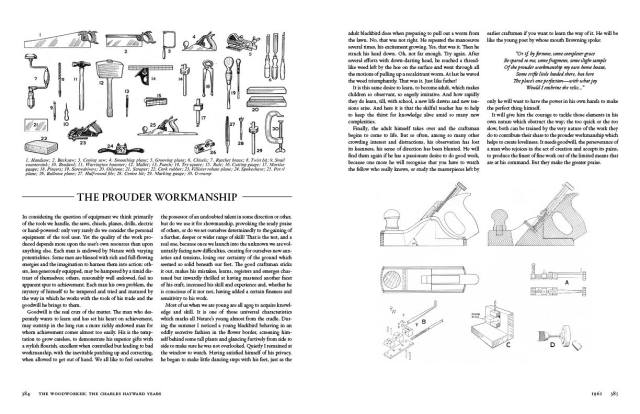
Every page spread in the book consists of one column only, illustrated with line drawings from the magazine that were published during the same year the column was written. The illustrations were also made by Hayward.
Here’s a small sample of one of the columns from the 1960s. Like a lot of good writing, it’s difficult to divorce a piece from the whole without diminishing it.
How easy for anyone having sufficient professional skill to get away with a semblance of truth. There are some craftsmen who simply take it for granted. The lack of precision in marking up, the careless cut, the small faults which declare themselves when a piece is assembled. Such a craftsman knows all the answers. “Oh I can soon put that right,” he says easily. And he can, filing, adjusting, smoothing, gluing here, screwing there, using as much casual skill in faking as in making. The furniture he produces may deceive the untrained eye but by any true standard it falls short. Without perhaps even being aware of it, the casual craftsman lets himself down more than anyone: the real damage is to himself.
It is all too easy, demanding no particular effort, no particular sense of responsibility, either to himself or to anyone else. But anyone who wishes to lift himself out of the rut, as a person as well as a craftsman, needs to feel responsibility and to be committed to a standard. Only in this way can he keep the sense of effort alive, and to cease from effort is to die before our time.
“Honest Labour” is going to be a sizable book – 488 pages – the largest book in The Woodworker series, and will have the same manufacturing specs as the other books in the series so they look good on your shelf. We hope to deliver it to the printer by the end of the month for a release in April or May 2020.
We know this is an odd woodworking book and that a lot of people will be skeptical, so we are doing everything we can to keep the price as reasonable as possible. And we are prepared for it to be a commercial flop. That’s OK, as we consider it an honest labor of love.
Today I was working on the layout for “Honest Labour” and had to revisit the 1936 volume of The Woodworker magazines. I stumbled on this delightful and ingenious way to explain and demonstrate how wood twists as it dries. Read the original text below and check out the illustration.
— Christopher Schwarz
Every woodworker knows that a certain shrinkage in wood is inevitable, and most know (to their cost) that a board will sometimes twist. Probably the majority connect the two phenomena, and say that a board twists because it shrinks. But this is only a half truth. It is true that the twisting would not take place if the wood did not shrink, but it is quite possible for a board to shrink without twisting. In fact, every well-seasoned board does so. Shrinkage has to be accepted as inevitable, and the fact that a board has remained flat goes to prove that the shrinkage can take place without twisting.
To revert to our subject, however, assuming that a board has twisted, that is become hollow, who can explain why this has taken place? An excellent practical demonstration of what happens is shown in the accompanying photographs. First a piece of paper about 6″ wide and 2′ long is folded up across its width in a series of folds, rather like a fan. The whole thing is then opened out at one side so that a circle is formed (like a double fan) as in Fig. 1, and the joining edges are glued together.
Across the face of this a series of lines is drawn with a brush and black ink. The lines at A are meant to represent the cuts that would be made in a log to produce plain (flatsawn) oak. That at B is a solid square of timber, whilst the C boards represent figured boards (quartersawn) cut radially from the centre.
Now shrinkage takes place around the annual rings, and it is obvious that if a log were never converted it would have to split, because the shrinkage would mean that the length of its circumference was becoming less. In the demonstration it is assumed that the splits have taken place at the two sides, and consequently two cuts are made at these two points. The spring of the folded paper will cause the whole to assume the shape shown in Fig. 2, and this is precisely the shape a split log would assume.
The originally straight lines of the conversion of the plain (flatsawn) boards A are now all curved, the square at B has shrunk badly at one side, whereas the figured (quartersawn) boards, C, remain straight. Thus we can see why plain oak is so much more liable to twist than figured oak, and why the boards always twist with their edges away from the heart. Thus in a twisted board it is always safe to say that the rounded side is the heart side. Furthermore, by an examination of the end grain is is always possible to say which is the heart side, and which way it is liable to twist if at all.
Exekias’ signature (ΕΧΣΕΚΙΑΣ ΕΠΟΙΕΣΕ) as potter, rotated 90° anti-clockwise, detail from a scene representing Herakles and Geryon. Side A from an Attic black-figure amphora, ca. 550–540 BC.
I have often wondered what period of time must elapse before a good craftsman becomes an outstanding one. Was he born that way, needing only the requisite skill to develop his genius? Or did he evolve stage by stage like other men, but having the courage to take his work a stage further, perhaps many more stages than other men will venture.
Yet that may only imply the virtue of persistence, not that he is outstandingly gifted. What is the secret? We can add together the small perfections which make up the quality of a first-class man but, even so, something eludes us, something in the very essence of his work which defies analysis.
There is an old Breton proverb which says: “Qui aime son métier, son métier l’aime.” It may be this puts a finger right on the spot. That there has to be love between a man and his work, something which each gives to the other, which acts and interacts upon his skill before craftsmanship becomes the superlative thing that is created beauty.
Probably many more men than we can possibly estimate, working at the handicraft they enjoy, are producing work of this kind today, to be seen by few people, but to some of those few communicating that little thrill of pleasure which only superlative work can give. When we think of the amount of wastage there has always been right down through the ages by reason of material change and decay, the destructiveness of wars, accidents, sheer stupidity and thoughtlessness, the marvel is the amount of creative beauty which must have been produced by unknown men in every age for so much to have survived into our own, infinitesimal in comparison with what has been lost.
Furniture, of its nature, cannot date back many centuries, as much, perhaps more, through neglect due to changing fashion than from the perishability of wood. But ancient records and wall paintings have yielded up a great deal of information about the furnishing of kings’ palaces and the like, and many ancient craftsmen’s masterpiece has been described in meticulous detail, which still seems to retain the sense of wonder of those who had seen the work and the proud sense of possession of the monarch who had owned it. Very occasionally, by one of the freakish chances of history, the name of the craftsman will have survived while that of his noble patron is forgotten. A strange reversal in values.
In some cases, conscious that this work of his was good, the craftsman has inscribed his name on some obscure corner, to be discovered years afterwards by men who came to admire. It is not often the craftsman inscribes a friend’s name as well as his own, yet this is what happened when, between two to three thousand years ago, a Grecian artist wrote his signature in tiny, crabbed Greek script: “Exekias made it,” on the lovely vase he had made and painted, and then in a burst of pride and affection: “Handsome Onetorides.” And so the name of his handsome friend has been passed down through the ages in somewhat unsual confirmation of Keats’ “A thing of beauty is a joy for ever.”
Had the maker instinct of immortality when he inscribed his friend’s name on the lovely thing he had just completed? Exekias himself was known as the finest Athenian vase painter of his day, and the vase is the famous one painted with a panel in which with consummate skill he shows the two Homeric warriors, Ajax and Achilles, seated at an improvised table playing a dice game. The two figures, painted and incised in black upon a red ground, are bearded and every line of their bodies as they bend forward shows a kind of eager intensity, but there is nothing to suggest that the handsome Onetorides was a model for either. No, the inscription seems to have come out of the fullness of the artist’s creative joy, knowing this work of his hands to be good and wishing to associate with it the name of the friend he admired. Rarely has a dedication been made with such simplicty and rarely has any dedication lasted so long.
Probably when we come to the word “dedication” we come to the crux of the whole matter. The man who is going to do outstanding work in any craft has himself to be a dedicated man. He must be sensitive to beauty wherever he sees it and in whatever form and have the instinct to turn to beautiful accomplishment the handicraft he has made his own. He has to have skill so sure and informed that it will carry him faithfully through his undertakings, enabling him to tackle new kinds of work with the confidence of experience.
But all this the really good craftsman can have. If he wants to go further still, it can only be for the love of it, something which will bring an element into his work which no school can teach, a heightened degree of skill, a suavity, a finish, which can only happen when, as the Bretons say, the work loves him back.