Illustration from “The Boy Craftsman: Practical and Profitable Ideas for a Boy’s Leisure Hours (with more than 400 illustrations by the author and Norman P. Hall)” by A. Neely Hall (Boston, Lee & Shepard, 1905)
“Persistence and the courage that goes with persistence are needed, but as the work grows so does the interest. We end by finding ourselves entering upon a new and most illuminating heritage, illuminating because only by the intent, patient work demanded by a craft do we really discover ourselves, our possibilities, our strength, and our weaknesses. By committing ourselves to it we grasp a chance to develop as personalities, ready to act, to accept challenges and have a kind of endurance. We learn to reason our way out of the bad patches and with the help of a little ingenuity to rectify our blunders. Better still, we learn how to avoid them. Best of all, we discover the amount of quiet satisfaction that grows in us once our creative instincts have found an outlet. Fine furniture is always a joy to behold. It is a greater joy still to make it.”
I’ve always used octagonal legs on my stick chairs because the geometry makes sense to my modern head. Cut the four-sided leg from a plank. Then plane down the four corners to create an octagon.
But when you study old chairs, hexagonal legs are far more common than octagons. I’ve given a lot of thought about how to create hexagonal legs at the bench, but it seemed more complicated than it should be. After talking it over with chairmaker Chris Williams in Wales, he arranged for a day in the workshop with Gareth Irwin, a Welsh chairmaker, turner and green woodworker. (His Instagram feed is definitely worth following.)
We met at Hugh B. Haley’s workshop, Phoenix Conservation, which is where Chris works when he isn’t building chairs in his garage. After Hugh made us some much-needed coffee, Gareth pulled his tools from his van. And in about 10 minutes, he made the process seem effortless and obvious.
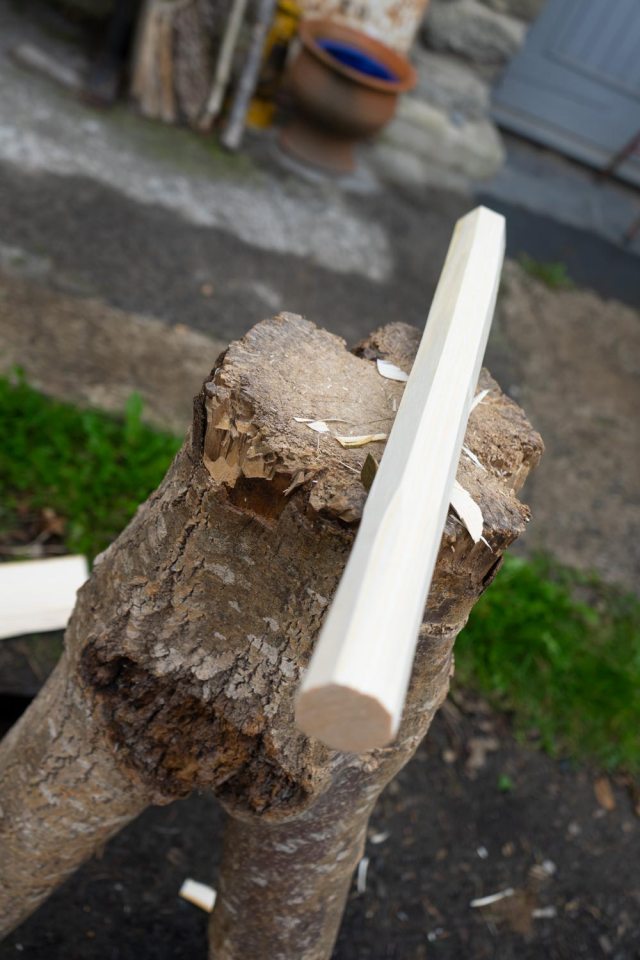
The key to make it easy is to work with wood split from the tree – not sawn stock. Gareth brought along a section of fresh young field maple to demonstrate. The hexagon is derived from the natural pie-shaped sections from the log. Here’s a quick photo essay that shows the process.
Here Gareth makes the first split across the pith of the log, splitting the log in half and then into fourths and eighths.
He splits off the pith and some other heartwood that could be used for something else, leaving a section of the tree that, after a little hewing, is roughly hexagonal.
At the shaving horse, Gareth refines this shape. Thanks to the hewing, there is always a flat section of the leg that rests on the stage of the shaving horse.
Gareth tapers the hexagonal leg with a drawknife and then starts to make the tenon at the top of the leg. He stops when the tenon is oversized. Then the leg gets dried for three or four weeks inside before he forms the finished tenon.
The demonstration was brief, and so we all got to chat a lot about the craft (and drink more coffee). Gareth brought one of his chairs along. It sits and looks fantastic. In fact, a local stopped by and purchased the chair from Gareth under our very noses.
Though I’ve been happily married for 25 years, I’ve had a number of intense love affairs – the kind that make you want to write bad poetry and buy good lumber. These affairs are, of course, with pieces of furniture I’ve encountered through the years. And while the opening sentence above might seem a joke, it’s actually not.
When I get fixated on a piece of furniture, I daydream about it. As I drift off to sleep I think of its curves. When I drink my morning coffee I ponder its construction. During the day I build the piece in my head over and over. The only way to stop my obsession is to consummate the relationship by building the piece.
On Friday I visited St Fagans National Museum of History and met my latest dalliance – Chair 024, a three-stick chair in one of the public spaces in the museum. I won’t write a poem about the chair – I’ll leave the poetry duties to other bloggers. But I will share what attracts me to this form, and I will also apologize in advance because I’m likely to write quite a bit more about it in the future.
First is the overall form. The chair has an armbow with a somewhat shallow curve, a bit like the low-back Cardiganshire chairs I discussed earlier. Yet it has a charming (and unusual) three-stick back with a simple and compact crest rail.
Second is the seat shape. I’ve not encountered a seat in this shape before and don’t have a name for it. I love how the seat reflects the shape of the arm above and that the seat has extensions at each end that mimic the round hands of the armbow.
I love the beefy sticks. In North America, we tend to prefer thin and tapered sticks, which can lighten the look of a chair dramatically. This chair will have none of that. The sticks verge on 3/4” in diameter and have little or no taper to them.
I adore the hexagonal legs. I’ve been itching to make hexagonal legs because that shape is more common in the historical record than octagonal legs. I’ll write more about hexagons and how they were likely made in a future blog entry.
Finally, I like the compact size of the chair. It’s not terribly wide or deep, and that characteristic has always been attractive to my eye.
I know that some (many?) of you might fail to see the beauty of this chair. You might even find it ugly, and that’s OK. Girls in my high school thought the same of me. It took only one woman – blinded by love, I suppose – to make me happy for the rest of my life. Except when we visit museums, and my wandering eye finds a shapely oaken leg….
Students in Will Myers’ October 2018 Shaker Candlestand class.
I know it looks as if we’re running a woodworking school, but when classes aren’t going on (which truly is the majority of the time), the Lost Art Press storefront is Christopher Schwarz’s working woodshop and publishing office where he develops furniture ideas for new books, and works on editorial and design for upcoming titles. (And he generously allows Brendan Gaffney and me to hang out there and produce shavings, too.)
But the classes are a lot of fun…so we’ve added a few more for 2019, including several from Chris, who’s easing back into teaching after a couple of years of taking it easy (on that front, anyway), along with some guest instructors (including Roy Underhill, and the return of Chris Williams from Wales!). Plus, we’ve added a handful of one-day, three-day and week-long classes. Almost all the classes have room for no more than six students, so you get a lot of personal attention from the instructor (whether or not you want it!) and his or her assistant (which is often Chris, Brendan or me). Plus, you can try out our tools (well, I volunteer mine, anyway) and seven different bench forms, and relax (as time allows) in the Mechanical Library or in the biergarten. And there is usually a group dinner and visit to a local watering hole. In short, it’s a great time.
This Friday (Oct. 12) at 10 a.m. Eastern, registration goes live for the January through June 2019 classes listed below (we’ll announce July-December classes in early 2019). Click through to each to read the full descriptions. If you’re interested – and I hope you are – I recommend being poised at your keyboard at 9:59 a.m. Eastern; these tend to sell out quickly. But do sign up for the waitlist if you don’t get in right away; life happens and things change. And if you can’t make it for a class, the storefront (837 Willard Street, Covington, Ky., 41011) is open on the second Saturday of every month from 10 a.m.-5 p.m. for all your Lost Art Press book needs, woodworking questions, tool instruction and more.
I’m sitting at Pantry Fields, the homestead where John Brown wrote “Welsh Stick Chairs,” in a massive chair that was built by John Brown. And I’m surrounded by JB’s family and friends, who generously allowed me into their world on Tuesday for a chat and a delicious bowl of cawl.
It’s a scene I could have never even imagined when I purchased a copy of “Welsh Stick Chairs” in the 1990s – a book that changed the course of my life as a woodworker. Across the table from me is Annie Seymour, JB’s ex-wife and potter. To my left is Molly Brown, one of JB’s daughters and an illustrator, and David Sears, Annie’s husband, woodworker, brewer and long-time companion to JB. To my right is Chris Williams, who had brought us all together.
I was in such a shock that I barely spoke for the first hour. Two things restored my tongue.
The first was Pantry Fields itself. Though I was thousands of miles away from the wilds of Arkansas, the environment felt familiar. Like my family and our farm, the people sitting around this oak table had built Pantry Fields from nothing using the materials around them – railroad ties, recycled windows and even two railway carriages.
The second thing was the wooden item in the image at the top of this blog entry. David Sears laid it on the table and explained.
It was a plug for a peephole that John Brown had used. When he heard someone pull up in a car, JB would remove the plug and peer out to see who it was in order to decide if he would answer the door or not. JB had drawn an eye on the end of the plug, which was a delicious touch to a quirky story that explained a lot about the man. I couldn’t help but laugh.
Pantry Fields, as always, is a work in progress. Annie and David are expanding and improving the buildings. There’s a gallery filled with beautiful pottery, furniture, books and prints. Even an ersatz and delightful bar that David has built. It seems as if something is brewing (and not just David’s beer).
This was just 10 minutes of my first journey to Wales, a five-day trip that has been a visual and visceral tsunami. I hardly know where to begin writing about it.
In some small way I feel a bit like like JB, deep in the workshop and looking out through a peephole at the world. And wondering what is coming down the drive in my direction.