This Saturday we are opening the doors at Lost Art Press, and there is a lot of stuff going on. Here are the parts that I can remember:
Tools. Brendan, Megan and I are selling off our excess tools. I’m still digging stuff out of the basement. Everything will be priced to move. None of us own junk. All tool sales are cash.
Book-release Party. Suzanne Ellison, the Saucy Indexer and LAP researcher, is making her first appearance here. Suzanne and I are going to present our unexpurgated history of workbenches on Saturday night. At the party we will give you drinks. Suzanne has party favors for everyone that she has made. We have a few spots left for this free thing. Sign up here.
Special guests. Jameel and FJ Abraham from Benchcrafted will be there to poo upon our Roman workbenches. And they have cool Chatoyance stickers to sell.
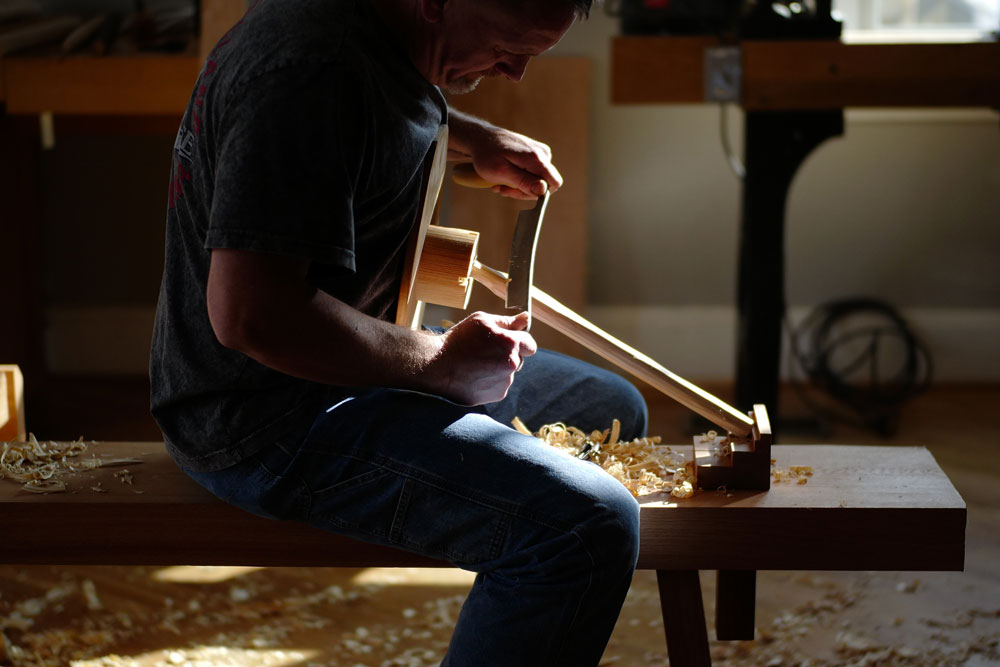
Another special guest – Mark Hicks from Plate 11 Workbench Co. – will be there with shavehorses. (We bought one and he is bringing an extra one I believe). Give them a spin and talk workbenches with Mark, Jameel and me (if you dare).
Books. As per usual, we will have the complete line of LAP books available for sale, plus T-shirts.
Finally, a couple food notes. If you are here on Friday, go to Braxton Brewing and get yourself a fried chicken sandwich on a biscuit from Bakers Table’s pop-up shop. And when you are here, make sure you eat at Main Street Tavern. It’s right around the corner from us. We eat there way too much. The brunch is cheap and incredible (it’s offered both Saturday and Sunday).
Looking for a place to stay? Definitely Hotel Covington. It’s a seven-minute walk from our store. The restaurant there – Coppin’s – is outstanding.
Alright, enough of my unsponsored blathering. Hope you can stop by on Saturday.
Editor’s Note: In addition to making the last edits to the book, we’re working on some final approvals from museums, the index and the cover. We hope to offer pre-publication ordering in August.
Late into the nights and early in the mornings before my class at Port Townsend School of Woodworking last week, I was working through my review of “Hands Employed Aright: The Furniture Making of Jonathan Fisher (1768-1847).” Until now, Fisher’s complete woodworking story has existed only in my mind. Because no furniture researcher has known of Fisher, the way all the tiny pieces and rabbit trails come together has never been put to paper.
I have, of course, several binders jammed with notes and papers and countless documents and images on my computer that contain all the little pieces I’ve gleaned on this journey. But it’s taken me years to put it all together into a coherent narrative. As I’ve made my way through this material, I’ve managed to clench it at the forefront of my memory but this story has been burning in me for years and so I couldn’t wait to see it in its final form.
When Kara sent me the PDF for author review, I was ecstatic. Reading the book in this final presentation (photos and all), it’s almost as if I was experiencing this story for the first time. I cannot express how delighted I am to be working with Lost Art Press on this book because there is no other publisher I would trust with this material. From the very beginning, Chris put his faith in me as a researcher and author, recommending minor editorial changes only for clarity. This freedom allowed me to dive deep in Fisher’s life and to present him in the way I think he deserves to be presented: in his unvarnished brilliance. My goal in this book was to allow Fisher’s life and work to emerge unfiltered.
Even though I’ve known the significance of the survival of his tools, furniture, house, and journal records for a long time now, seeing it all together in the book blew me away all over again. I’ve had the same conversation time after time with furniture researchers – when I tell them Fisher’s story, they all say, “Wait. How come no one has ever heard of this before?” This is a good question. A handful of Fisher biographies have been written but because each book had a different focus, his woodworking activity appears as little more than, “Oh. And he even made his own furniture! How neat!” Yet there in the Jonathan Fisher House and Farnsworth Art Museum archives sat one of the most complete survivals of a pre-industrial cabinet and chairmaker’s story unidentified and undisturbed.
When I was in Port Townsend last week, I spent a few evenings visiting with Jim Tolpin. As I told Jim of Fisher’s story, we discussed how not only is the completeness of the artifacts important, but the fact that it documents a rural craftsman’s work makes it particularly exceptional. Most furniture research focuses on the most successful and prolific master cabinetmakers in the big cities but not just because of a lack of interest in rural work. The tragic reality is that very few rural artisans documented their work and even fewer have two centuries of descendants that carefully preserved their artifacts. Their life’s legacy has long been discarded and their stories are gone forever.
Jonathan Fisher’s story is an incredible exception to this.
Reading through the book, I’m reminded of how spending this time with Fisher has profoundly changed me as a craftsman. Five years ago, when I began crawling under that furniture to read and understand his tool marks, my perspective on the way woodworking can shape our lives began to broaden. In Fisher, I saw a man that knew no boundaries. He made chairs, tables, chests, agricultural items, hats, picture frames, tools, paintings, and even his own wind-powered sawmill and workshop.
There are many questions about Fisher’s woodworking career I was able to resolve but many still remain. The one that nags me the most is, “What was it in Fisher that made him so boundless in his pursuits? What was it that gave him the confidence to pursue activities that were yet outside his skill set?” Throughout his whole life, Fisher continually explored new trades, in most of which he found success. Jonathan Fisher has inspired me to loosen the shackles of specialization that today’s consumer culture tries to bind us with. I do not believe we need experts to hand us pre-packaged products fit for immediate consumption because Fisher exemplifies a compelling alternative. Jonathan Fisher teaches us to boldly explore new craft vistas to build a life with our own two hands.
Detail from Albrecht Durer’s “Melencolia 1,” 1514,
There are a number of geometric constructions that allow us to create regular (i.e equal-angle and equal-facet length) polygons. Most of those for squares, rectangles and triangles are quite straightforward, requiring but a few steps. However, those dealing with five or more sided polygons get quite tedious involving numerous exacting steps.
Traditional artisan’s constructions are far simpler and each work in the same way to create polygons of any number of sides. The caveat is that they do not generate perfect vertices and therefore do not form regular polygons – i.e. they are approximations. Their products are so close, however, that we cannot see the difference in most drawing and furniture-scale applications. In constructions such as building foundations or landscape layouts, the deviation is a bit more evident. The constructions can, however, easily be “tuned” to near perfect by making small adjustments in the step-out procedures. Here’s a look at three trade-practice methods to create a seven-sided “heptagon.” More details and full instructions for executing these methods are available as a download (free for the next 10 days) at our www.byhandandeye.com shop page.
We use this construction when we know the length of one of the facets of the polygon we wish to generate. Basically, it gives us the focal point of the inscribing circle:
We use this next construction when we know the radius of the inscribing circle. In both of these methods, we are segmenting a line into the number of facets required by our polygon. (In the first, we are segmenting a half-circle circumference line, in the one below, the diameter):
The fastest method, however, is attained through the use of the sector (which you can download for free in the form of a paper template at www.byhandandeye.com).
Using the “line of polygons” (which we derived from another traditional calculator called a “scale of chords”) we start by setting the dividers to the radius of the inscribing circle at the line’s “6” index point:
Then we reset the dividers to the number of facets we want – in this case at “7” for producing our heptagon:
When we step this span around the circle, we have our construction. Again, because this is just an approximation, we will likely have to make a tiny adjustment to allow the dividers to return to the exact starting point. Be assured, though, that you will be so deep in the ballpark with any of these traditional methods that you’ll be able to smell the hot dogs.
It’s difficult to believe that it has already been 10 years since John Brown died on June 1, 2008. It’s even more difficult to believe that his landmark book “Welsh Stick Chairs” is not in print.
With a little luck, we hope to have “Welsh Stick Chairs” in your hands in June 2018 for the 10-year anniversary of his passing. Today I uploaded the final files to our printer and they should start production on the book on Monday afternoon.
We hope to open pre-publication sales of the book next week. We’re still waiting on a couple elements of the print job to make sure we have the costs correct. We’re shooting for $27 to $29, which will include domestic shipping.
Note that we have the rights to distribute “Welsh Stick Chairs” only in North America. Not in Europe, the UK or – oddly enough – Wales. We’ve been told another publisher in the UK will be publishing a version for that market. But we don’t know when or what it will look like.
Ours will be printed in the United States on heavy and smooth coated paper. The signatures will be sewn for durability. And the book will be covered in heavy 100-pound Mohawk cardstock with a vellum texture. (We love Mohawk paper – it’s made with wind power.)
The dark blue cover will then be stamped with a matte silver foil. It’s going to look crisp and have a lot of nice textures.
When I was a kid, my family had a wide selection of “bathroom books.” These were books that had been taken down from the shelves on a whim and left behind on the shelf above the toilet, either because their contents were intriguing or seemed appropriate for a brief perusal. I remember a manual on grading gravel roads, a book of palindromes and, most memorably, one called “The Art of Chindogu.” Chindogu, as I learned over many short reading sessions, is the Japanese art of the unuseless (yes, unuseless) invention. These creations either fulfilled a need or solved a problem, with the catch that the solution was often overbuilt, silly looking or impractical.
What I grew to like about chindogu was the enthusiasm and professionalism with which the wacky, hyper-specialized or odd inventions were pursued by their inventors. Each one was (somewhat) professionally manufactured and photographed, despite being prototypes that were never meant to be sold. They seem like a byproduct of the design process – sometimes, pursuing something niche, unprofitable or outlandish can teach us a lot about our work that doesn’t fall to such an extreme.
And so, I spent last weekend with Narayan Nayar and Daniel Clay in a coopering class at Tillers International learning to make a handled bucket, called a piggin, despite having no need or particular desire to begin producing buckets or barrels.
Don’t get me wrong – the world still needs coopers and new barrels. Our teacher, Eric Edgin, makes vats and barrels for food fermentation. Just last January, Eric traveled to Japan to learn more about the art of soy sauce vat making. Coopering is also full of clever solutions to unique problems. Coopers have a wide range of woodworking tools and techniques that are at once specialized and widely applicable.
One of Eric’s fermentation vats, made during his trip to Japan. Photo by Narayan Nayar.
But coopering is what I would call an unuseless skill for my work. I don’t plan to make barrels, buckets or piggins any time soon. It was fun to make a bucket entirely by hand, with only a few sharp tools, but the work in no way resembles my own.
The solutions that coopers have found to their particular set of problems, however, are likely to impact or inform the way I do a few things in the shop. The use of a stationary jointer plane, to which one brings the workpiece, makes a lot of sense when tuning the edges of beveled and tapered parts. The “clapper gauge” is really a specialized style of sector, which accurately measures the outer angles of a stave against a desired diameter. The shavehorses used are familiar looking, but the use of a “belly” is common, as are all sorts of clever body mechanics and workholding.
Just like I was looking for an excuse to study something outside my usual practice, I was also looking for a reason to head to Tillers International. Located outside Kalamazoo, Mich., Tillers runs what I call a friendly “Robin Hood” non-profit model. The school teaches classes on woodworking, metalworking and all manner of skills for traditional homesteading and farming to those who can pay for them. Then, Tillers use that money to teach those same skills to those who cannot afford to pay for these classes. The organization has worked with people across the globe and is explicitly dedicated to improving the lives of people in rural areas worldwide, by teaching them skills they can use to be self-reliant and independent. This makes the act of paying a sum of money to learn to make buckets all the more sweet – it’s definitely going to a good cause.
It was a joy to spend time in a beautiful place with good friends, honing my bucket-making skills. I did not walk away a cooper – but I did walk away a furniture maker with a few new tricks. These skills may take some time to come about as a need in my work, but sometimes, a little inspiration from a bathroom shelf or an age-old vessel-making tradition is just the kind of inspiration or enrichment you need. Who knows? Maybe I’ve got a few round cabinets in me.
(From left) Me, Eric Edgin, Narayan Nayar and Daniel Clay with our brand-new buckets.