Of working men’s clubs we have in England alone, of one kind or another, about 700; of clubs for working women, so far as we know, but one, and that is one not provided for the class of women to whom we here more particularly refer. Is not this something for our working women to think about? These clubs provide comfortable rooms and attractive amusements, books to read, and in most cases classes for instruction and lectures. Why should not working women have the same advantages? Think of it, working women in the furniture and upholstery trades,—think of it, and act upon the suggestion it offers you.
“Nations which owe their origin to the conquests of successive invaders, however generous and noble in their natures such invaders may be, are not those in which the true rights of women are speedily recognized. In the first place, the wives of the invading race are sought amongst their captives; and it is not likely that the daughters and wives of the slain or defeated could very readily submit themselves to the wills of their imperious and exulting captors. Harsh and cruel treatment systematically indulged in, watchful suspicion, and the enforcement of a slavish spirit of humility and obedience, would, on one side, naturally be the weapon of the enslavers. Falsehood and treachery, the vices natural to a state of fear and degradation, would be the weapons of the enslaved. Thus a relationship would spring up between the sexes anything but honourable or satisfactory to the one or to the other; and it would require long, long years of successive generations to modify that relationship, and gradually beget a feeling of mutual respect, regard, and equality.” (more…)
For the last decade, I’ve been a terrible sleeper. I wouldn’t call it insomnia, but I tend to wake in the middle of the night and think about everything I’m working on.
The solution has been to take melatonin. The upside: I sleep better. The downside: I have the most hyper-realistic dreams ever. Every night.
I’ve come to accept these dreams; but on occasion, they encroach on reality.
I have woken up some mornings convinced that my family has been killed. Or that I have drowned. Or that I am very good at diagnosing the peculiarities of hot air balloons. But the most alarming dream of all happened right after I returned from Australia this year.
I had a dream that I was employed at my old position.
I was in a marketing meeting. And the things that were said were so disturbing that when I finally awoke, I made myself a cup of coffee, sat in our sunroom for a good hour and just stared at the squirrels and cardinals in our yard. One word kept going through my head:
Whew.
It has been exactly two years since I left Popular Woodworking Magazine, and it has become obvious how unemployable I now am. I love to work all the time (12 hours a day, seven days a week, minimum), but I won’t implement someone else’s master plan. When someone suggests a dumb idea for a product for Lost Art Press, I don’t do hours of market research to come up with an empirical way to say “no thanks.” I just say “no thanks,” and move on.
When someone asks me to promote their product, I now (politely) refuse. Even if I like the product, I dig in my heels and decline. I don’t want to be part of anyone’s marketing plan. Yeah, I know that’s not a smart strategy for making friends and “partners.” But when I write about something – anything – I want it to be out of pure enthusiasm. No obligations, even social ones.
Offer me a discount and I’ll overpay you so that I think we’re on equal footing.
For me, this way of life is the hyper-realistic dream – better than anything that 10 tabs of melatonin could conjure from my frontal lobe. And it was made possible by someone I don’t talk about much on this blog: my wife, Lucy May.
I try not to drag her into the day-to-day operations of this blog. Her life as a journalist is public enough, and she doesn’t need me talking about the time I drew a sheep on her bare buttocks. (No, really, I didn’t do that. Honest. See? This is what I’m talking about.)
If it weren’t for Lucy, I would still be in that endless marketing meeting. I would still be employed at my old position. I would still lose sleep over small changes in the “sell-through” percentage of our magazine in bookstores.
But thanks to Lucy, I get up in the morning, I work until my eyes go out of focus and I then sleep. She tolerates the endless travel, the time in the shop, the writing, writing, writing. She never complains.
From W.H.C., Tenn.–I inclose you here with a sketch of my clamp bench for clamping doors, sash, blinds or any other work that requires to be held in the same general manner. I have been using a bench of this description for some 24 years, and have found it quite satisfactory. It is made of hard oak, well seasoned and well put up. The size of stuff or clamp is 3 x 5 inches. The height is 2 feet, and of course may be made to any length required. A tenon on the end of the top of bench is made to go through the jaw, in order to keep the latter from working either right or left. A groove extends lengthwise of the top one-half inch deep and 1 inch wide, in which a tongue on the slide fits. The strap of the slide is made of eighth inch by 1 ¼-inch iron, with half-inch round iron pins riveted in. The small sketch shows the general construction of the slide.
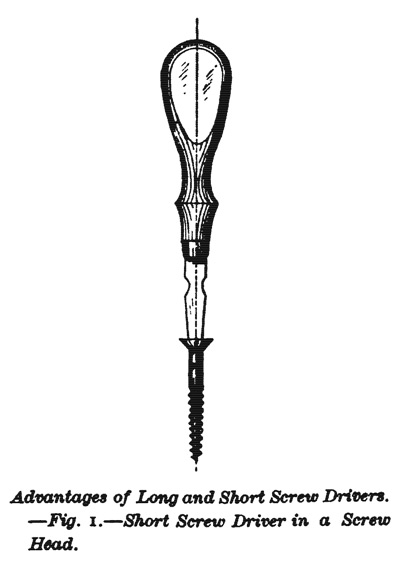
From L. R. H., North Argyle, N.Y. — Will you please inform me what philosophical principle is involved in the fact that a long screw-driver will turn a screw with less power than a short one? Can you explain the phenomenon to an unphilosophical subscriber?
Answer.—Our correspondent, in asking his question, virtually asserts that, with a long screw-driver, more power can be applied to the head of a screw than with a short one. This fact has often been denied, yet we believe it to be well established. The difference in the lengths of the screw-drivers admits of a difference in the manner of using them, and this difference in the way of using accounts for the difference in the power exerted. (more…)
“Well, I don’t call a monkey wrench a screw driver. I call a screw a thing with a slotted head, and a screwdriver, the thing that goes into the slot to turn the screw.”
That remark was made in the shop, and was pretty near correct. Outside of the shop no one ever thinks of calling anything a screw driver except the instrument used to turn slotted screws. I had almost said wood screws, but that would have discarded the screw driver most in sight, that little convenience that comes, and goes, with every sewing machine, to tempt the operators to get them out of repair, and which, it is needless to say, isn’t, sometimes, worth the powder it would take to blow it to Chic—, but after all, it serves its purpose—what more would you want? And it is used by more people than any other mechanical instrument.
In fact few domestic screw drivers are just what they should be; and carpenters screw drivers are not much better. Wood screws are of various lengths and sizes. You can get little bits of wood screws, an inch long, or you can get them, just the same length, as big as a lead pencil.
Here are half a dozen estrays now on my desk while I write; how, whence, or when they came I don’t know. They will do for samples, and they vary from an eighth to more than a quarter of an inch in size. Now it don’t stand to reason that the little screw—not much bigger than a knitting needle, requires the same size and kind of a screw driver that the big one does. (more…)